

Procedure
Ensure a thorough understanding of our treatments
Please read the information “The Patient’s Guide for Receiving an Operation in Japan.” As it is critical for us to have your consent, make sure that you understand what you have read and that you consent to the information. Then move on to the following items below.
Consult your primary doctor
Contact us
Please contact us by sending “Request An Examination” from here and provide us with as much detailed information as possible to fill out the “Description of your condition, symptoms and consultation” section. Especially if the pre-existing condition is serious, give a thorough description of it.
Record your voice
Once you submit a “Request An Examination,” the screen will automatically switch you to another on which you can record your voice and send it to us. With your voice data, a more precise diagnosis can be given and a feasibility decision can be made more appropriately made. Please note that we may contact you via e-mail to ask you for additional details on your condition after receiving your voice data.
Schedule your operation
After the feasibility check gives the “go ahead” to your surgery, we will set up the schedule for your operation by arranging the necessary examination and scheduling a time in the operation room and a bed for you in our patient facilities. We will contact you via e-mail or Skype to give you some schedule availabilities, so that we can discuss and decide on one of them.
Voice operations are routinely performed on Tuesdays and Thursdays. However, if your flight schedule doesn’t allow for these days of the week, please let us know.
Book your flight
Submit content forms
[File name: ICF_Thyroplasty_js-rvsd.doc]
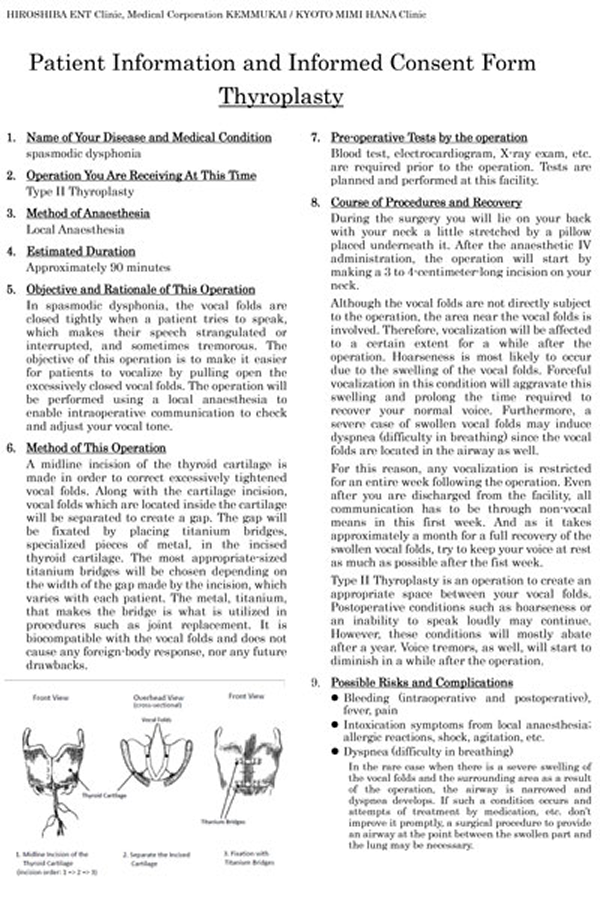
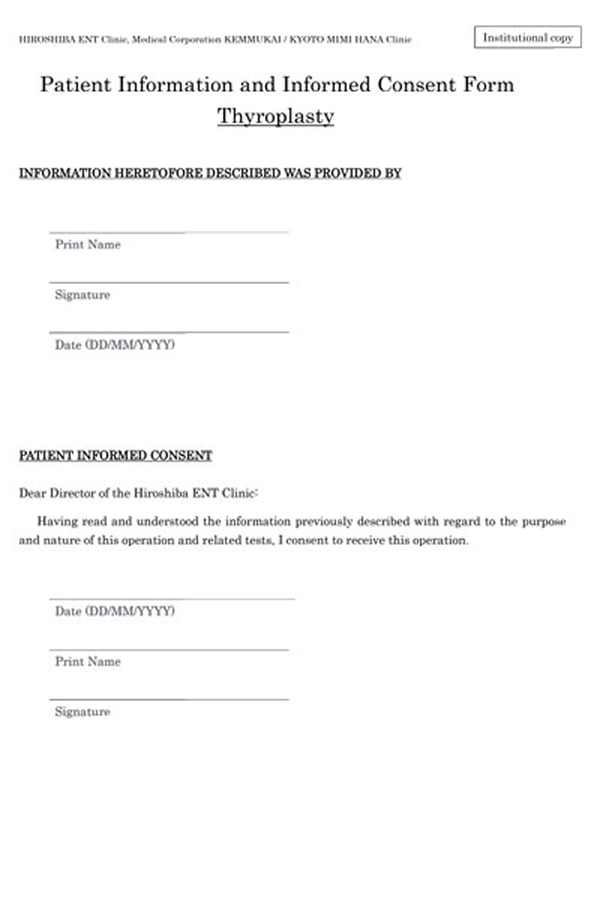
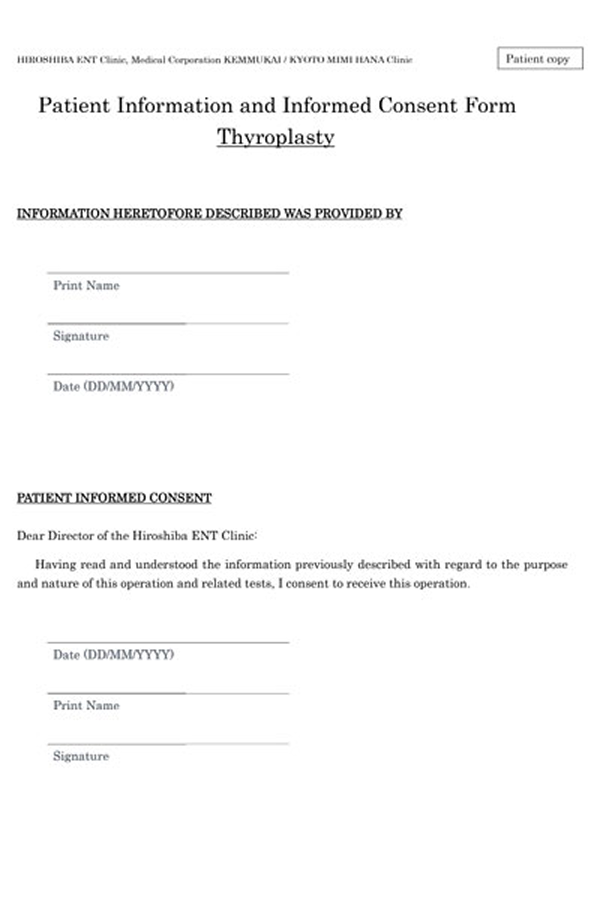
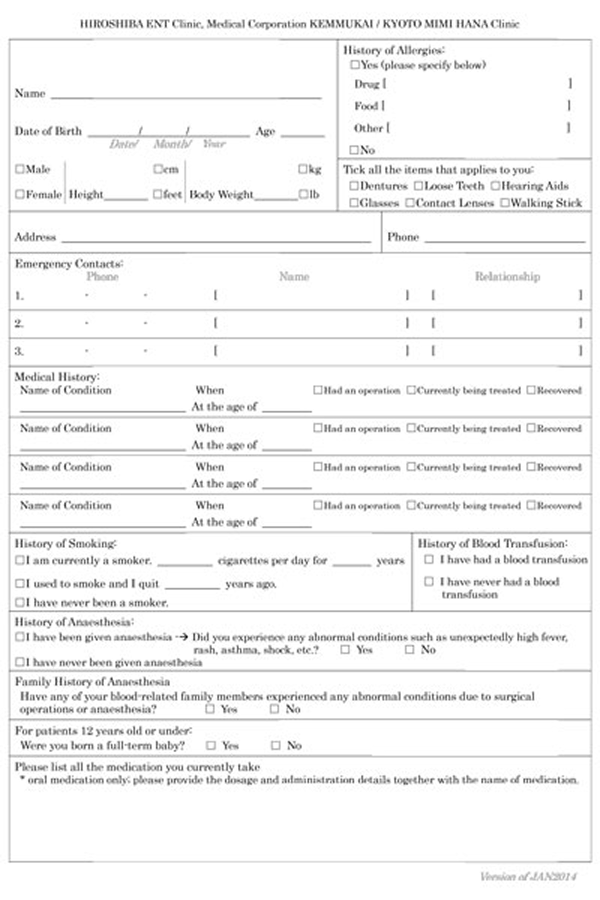
[File name: Patient Questionnairs_js.doc]
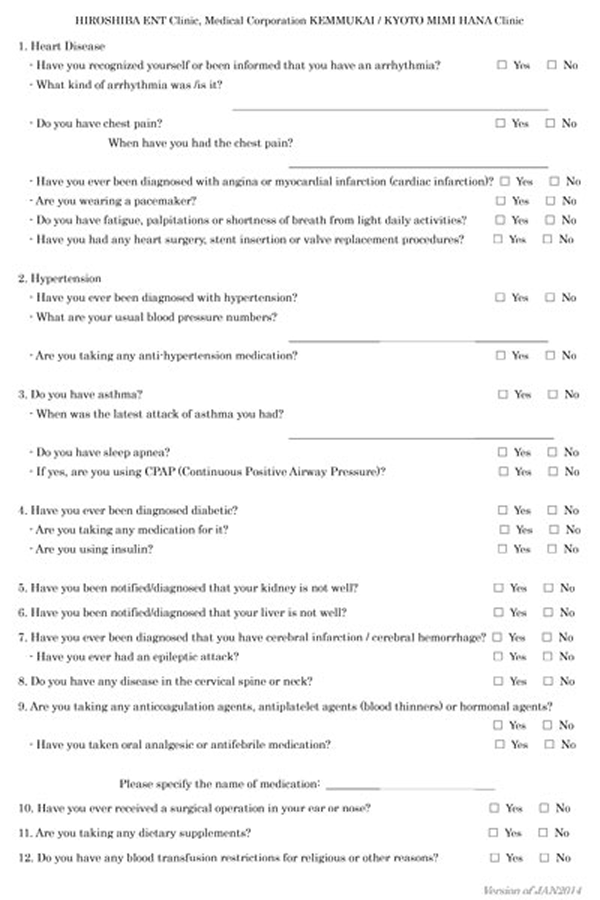
Pre-operative physical examination
You should have a pre-operative body check with your GP (ECG, chest X-ray, blood exam, and etc). Please send by email to us those data in an attached file. Or you can have a preoperative exam with us in our clinic in the morning previous to the day of surgery (additional charge) at which time we will judge whether you can receive surgery. Of course the drawback to having the examination here with us is that perhaps your medical condition will preclude your having the surgery, in which case you will have laid out a lot of travel expenses to no avail.
It will be necessary to stop medication for 2 weeks before surgery and a few days after surgery in the case of your taking an anticoagulant with your doctor’s permission.
Fly to Japan and visit Kyoto with a well-planned schedule
The Patient’s Guide for Receiving an Operation in Japan
Preoperative Medical Clearance
[ To take the preoperative examination ]
When performing a Preoperative Medical Clearance at your own country
[ Required inspection ]
- Electrocardiogram
- Chest X-ray
- Blood sampling
Blood sampling type
- ・Common test
- WBC RBC Hb Ht MCV MCH MCHC PLT Myelo Meta Seg+Band Eosino Baso Lympho Atypi-Ly Mono
- ・Coagulation test
- PT PT-INR PT-consumption test APTT
- ・Infectious diseases test
- CRP HBs RPR(LA) TP Blood Type RH HCV antibody C.O.I IgE HIV
- ・Biochemistry test
- TP T-Bil ALP AST (GOT) ALT (GPT) LD (LDH) AMY CHE CK TCho TG LDL-C BUN Cre UA Na K Cl GLU HbAic Hct
Preparation
[ Admission ]
- Please inform us of your food allergy or halal.
- You could go out on the previous surgical day after preoperative examination. However, It is impossible to go out on the surgical day.
[ In your room ]
- Smoking is prohibited on the premises of the clinic. We have concentrated oxygen for medical use and therefore need to strictly enforce this ban.
- Please keep the door unlocked in case of emergency.
- Please do not bring in too many electric devices/appliances. Mobile phone use is allowed in your room. Please let us know if you have a visitor with a cardiac pacemaker, etc.
- Please refrain from speaking loudly even inside your room.
- It is possible to accept one person to accompany with you.
- It is necessary for every patient to stay in the room up to 2 hours after surgery.
During Operation
[ Admission (check in at the reception desk on the 2nd floor) ]
- An Introduction and escort to your room
- Body temperature and blood pressure tests
- Preoperative examination including blood examination, ECG and chest X-p
[ Day of Operation ]
1. Before surgery
Please refrain from taking food 3 hours before surgery. We serve drip infusion just before surgery. We will escort you from your room to the operation room.
Please be sure to use the toilet prior to the operation for urination/defecation. For the operation, take off/wash off everything, e.g., facial makeup, manicures, accessories, dentures, glasses, contact lens, etc. Please manage your valuables and personal items on your own. A safe box is available in your room.
2. Surgery
It usually takes between 60 to 90 minutes. Local anesthetic injection previous to surgery may be a little painful, but it is enough toralable. We adjust your intraoperative voice. So you could choose your best voice intraoperatively.
3. After surgery
Postoperative attention
- Complete voice rest is required up to 3 days after surgery.
- You could take shower, any food just after surgery.
- You could speak after 3days after surgery, but refrain from talking loudly.


